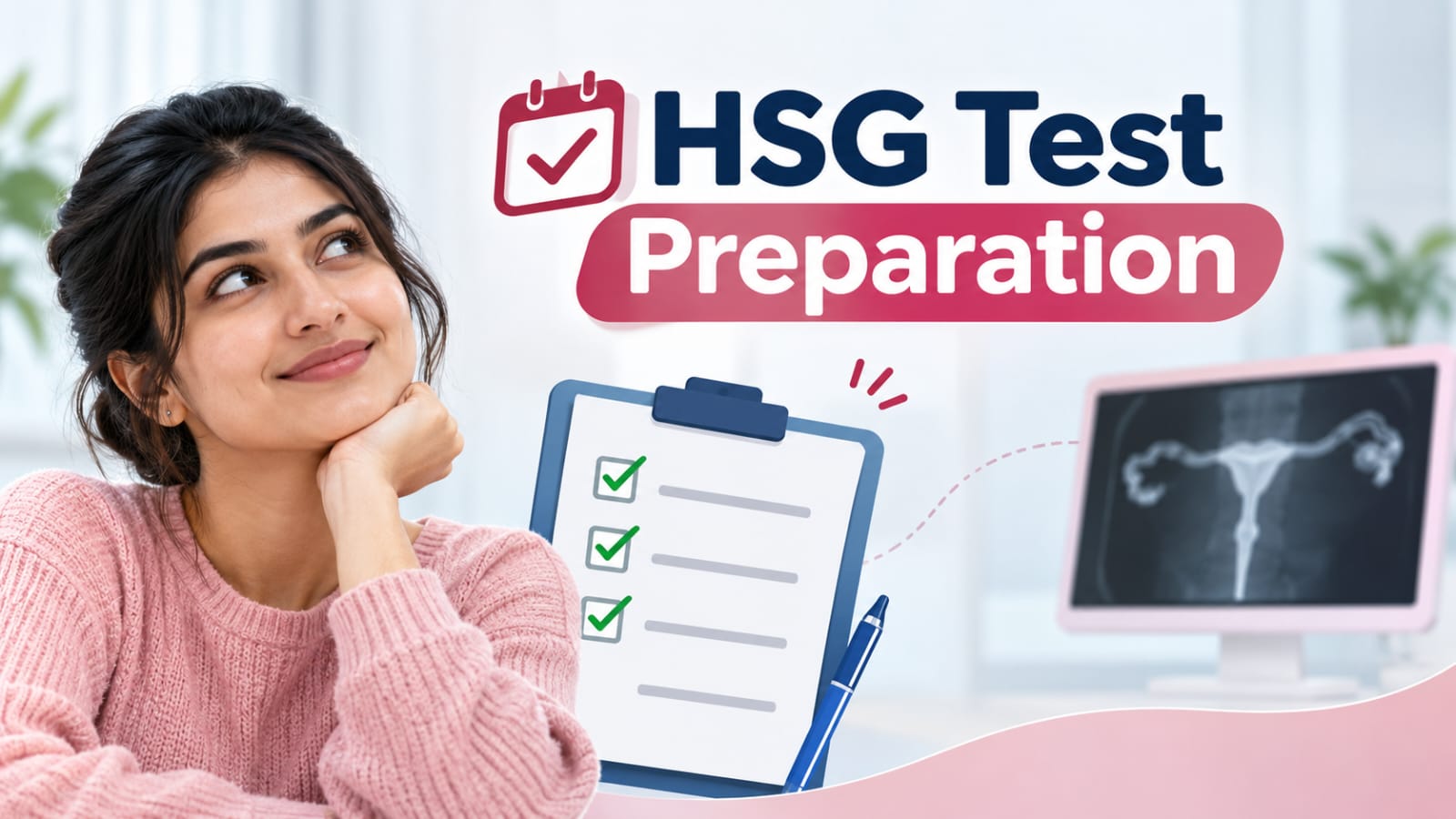
Quick answer: To prepare for an HSG test, book it after your period bleeding stops but before ovulation, usually Day 6–10 of your cycle. Eat a light meal, avoid sex and vaginal products as your doctor advises, take any prescribed painkiller or antibiotic on time, carry a sanitary pad, and bring someone with you.
Key Takeaways
Timing matters most. The test is done between the end of your period and ovulation, so call the clinic on Day 1 of your period.
No fasting is needed for a standard HSG. A light meal before is better than an empty stomach.
Pain varies a lot. Some women feel mild cramps, others strong pain. Ask your doctor about pain relief in advance.
Tell your doctor about any dye or iodine allergy, thyroid problem, infection or chance of pregnancy.
Mild cramps, spotting and sticky discharge are normal afterwards. Fever, heavy bleeding or severe pain are not.
An HSG (hysterosalpingogram) is an X-ray test that uses a contrast dye to check whether your fallopian tubes are open and whether your uterus has a normal shape. Good preparation makes the test safer, the images clearer, and the experience less uncomfortable. That means picking the right cycle day, ruling out pregnancy and taking pain relief on time. HSG checks your tubes and uterus, while your egg reserve is checked with an AMH test. Read more about low AMH but regular periods.
During the test, a thin tube is passed through the cervix and dye flows into the uterus while X-ray images appear on a screen. If the dye spills out of the ends of both tubes, they are open.
Doctors usually suggest an HSG when:
You have been trying to conceive for more than a year, or more than six months if you are over 35
You have irregular or absent periods, repeated miscarriages, or a past pelvic infection such as PID
Most of the stress around an HSG comes from not knowing what to do or what to expect. The rest of this guide covers that step by step.
Most doctors schedule an HSG after period bleeding stops but before ovulation, usually between Day 6 and Day 10 of the cycle. Day 1 is the first day of bleeding. This window lowers the chance of an unknown early pregnancy and gives clearer X-ray images of the uterus and tubes.
You may have seen several windows online. Some clinics use Day 7–10, others Day 6–10, and some allow up to Day 12. They all follow the same rule: the period must have finished and ovulation must not have happened yet. The exact window depends on your cycle length and your clinic's policy, so your doctor's date is the one to follow.
If your cycles are irregular or very long, or you have PCOS, there's no fixed "Day 6–10" for you. Your doctor will plan the test around your own cycle, often with a pregnancy test on the day and sometimes an ultrasound. Call the clinic as soon as your period starts. If you have PCOS, read our guide on PCOS and fertility.
Irregular cycles are common among women being checked for fertility problems, but most online guides skip them. One NHS hospital leaflet explains that for women with very long or irregular cycles, or no periods at all, the doctor makes a special plan to fit their cycle.
What you can do:
Track your cycle with a calendar or app for 2–3 months before the test, if time allows.
Call the clinic on Day 1 of your period, even if it comes unexpectedly.
Don't guess the day yourself. An HSG during a possible pregnancy must be avoided.
Ask whether an ultrasound to check ovulation timing is needed before your slot
Learn more about PCOS treatment options.
What should I do in the days before an HSG? (Day-by-day checklist)
Preparation starts the day your period begins. Note Day 1 and book the test in the right window. Follow your doctor's advice on intercourse, skip tampons and vaginal products for 24 hours before, eat a light meal on the day, and take any prescribed medicines on time.
Can I eat before an HSG test?
Yes. A standard HSG does not need fasting, so you can eat and drink normally. A light meal one or two hours before is a good idea, because many women find cramps or light-headedness harder to handle on an empty stomach. If you are given sedation, follow your clinic's fasting instructions instead.
MedlinePlus, the US National Library of Medicine's health site, says you can eat and drink as usual before the test. Some Indian fertility clinics specifically suggest a light meal.
Good options: poha, upma, idli, toast, fruit or curd.
Better to avoid: heavy, oily or very spicy food, which can make nausea worse if you get strong cramps.
Can I have sex before an HSG test?
Clinics give different advice. Some say avoid sex for 24 hours before the test; others say avoid it from the end of your period until the test. The goals are the same: to rule out a very early pregnancy and to lower infection risk. Follow your own doctor's instruction.
Here's how the advice varies:
Avoid intercourse for 24 hours before the test to prevent infection
Avoid intercourse for a few days before the test
Avoid intercourse from after your period until the test is done
Simple rule: if you had unprotected sex after your period ended, tell the doctor before the test. They may do a pregnancy test or change the date.
Which medicines should I take before an HSG test?
Your doctor may advise an over-the-counter painkiller about 30–60 minutes before the test, and in some cases a short course of antibiotics. Before the test, tell them about any allergy to contrast dye or iodine, untreated thyroid problems, a current infection, or any chance you could be pregnant.
Johns Hopkins' fertility centre suggests taking a common painkiller about half an hour before the test and again an hour after. Take only the medicine and dose your own doctor recommends, especially if you have stomach ulcers, asthma or kidney problems.
Not everyone needs them. An antibiotic may be prescribed before or after the test to prevent infection, and some women are also given a mild sedative for anxiety. They are more likely to be advised if you have had a pelvic infection before.
An allergy to X-ray dye or iodine. Allergic reactions to the contrast liquid are extremely rare, but your doctor still needs to know.
A thyroid problem. One NHS leaflet notes that the test will not be done if a known thyroid problem is untreated.
Pelvic pain, unusual discharge or fever right now, which may mean an active infection.
Any chance of pregnancy.
For many women, an HSG feels like strong period cramps that ease within minutes, but some find it very painful. Pain is often worse when a tube is blocked. Taking prescribed pain relief on time, asking about local anaesthetic, and slow breathing during the test can make it easier.
Many pages online say it's "just mild cramping." That isn't true for everyone, and knowing this in advance helps you prepare.
UCSF Radiology says many patients compare the discomfort to menstrual cramps.
In one woman's account, she rated her HSG pain at 9 out of 10, higher than her unmedicated labour contractions.
How much it hurts depends partly on what the doctor finds during the test. For example, dye pushing against a blocked tube can cause more pain.
Take the advised painkiller 30–60 minutes before, not when you arrive.
Ask about local anesthetics. Some doctors inject local anaesthetic into the cervix during the procedure.
Ask about a mild sedative if you are very anxious.
Breathe slowly and tell the team if the pain gets too much. They can pause.
Lie down for 10–15 minutes afterwards before getting up.
An HSG is mainly a diagnostic test, not a fertility treatment. However, a large Dutch trial found higher pregnancy rates in the six months after an HSG when oil-based dye was used instead of water-based dye. Treat this as a possible bonus, not a guarantee. The choice of dye is your doctor's decision.
What the research shows (H2Oil trial, 1,119 women in the Netherlands):
Important limits:
The women in this trial had ovulatory cycles, were aged 18–39 and had a low risk of tubal disease. The results may not apply to everyone.
Oil-based dye is not available or suitable at every centre
No test can promise a pregnancy.
Before your HSG, ask about the exact cycle day, whether you need antibiotics, which pain relief to take and when, which dye will be used, how and when you'll get results, and when you can start trying to conceive. Writing these down beforehand saves confusion on test day.
Save or screenshot this list:
Which date or cycle day should I come in?
Do I need antibiotics? When do I start?
Which painkiller should I take, and when?
Is local anaesthetic or a sedative an option?
Will you use oil-based or water-based dye?
Will I get the result the same day, or a written report later?
When can we start trying to conceive after the test?
What should I do if my period comes early or I'm spotting on test day?
Bring your prescription and old reports, a sanitary pad, comfortable clothing, ID, any prescribed medicines, and someone to take you home. A small bag prepared the night before means you won't forget anything on a stressful morning.
Test-day bag checklist:
Doctor's prescription or referral slip
Previous reports (ultrasound, blood tests, earlier HSG, if any)
A sanitary pad, since some dye and a little blood may leak afterwards
Loose, comfortable clothes
Prescribed painkiller and antibiotics
A water bottle and a light snack for after the test
ID and payment or insurance details
A companion
You can usually go home the same day, but it's better to bring someone. Cramps after the test can make driving, riding a two-wheeler, or a long auto or bus ride uncomfortable. Some centres also prefer that a companion be present.
Most facilities let you drive yourself home, but some require someone with you in case of cramping. In practice, a cab or a family member's car is the easiest option, especially if the centre is far from home.
In India, an HSG test usually costs about ₹2,000 to ₹8,500, depending on the city and the type of centre. Diagnostic labs often charge only for the X-ray, while fertility clinics may bundle consultation, medicines and reporting into a higher package price. Prices change often, so confirm before booking.
Prices are as published by these providers and may have changed
Why prices vary:
Whether a specialist consultation is included
Type of dye used (oil-based dye usually costs more)
Antibiotics, painkillers or sedation included in the package
Report by a radiologist versus discussion with a fertility specialist
City and type of facility
Planning your next step? See our guides on IUI cost in Patna and IVF cost in Patna.
Mild cramps, light spotting and a sticky, watery discharge (the dye coming out) are normal for a day or two. Most women go back to normal activities the same day or the next. Call your doctor urgently if you have fever, heavy bleeding, severe or worsening pain, foul-smelling discharge, fainting or vomiting.
The warning signs in the right column are listed by WebMD as reasons to contact your doctor after the test.
Most women can return to their usual routine by the day after the test. Use pads rather than tampons for a day or two.
Advice differs here too. Some providers recommend waiting at least one menstrual cycle, while some fertility experts encourage couples to try soon after a normal HSG. Ask your doctor which applies to you, because it depends on your results and whether antibiotics or further tests are planned. If your tubes are open, your doctor may suggest IUI, IVF or ICSI depending on your other reports. Read about the difference between IUI, IVF and ICSI.
How long does an HSG test take, and when will I get the results?
The X-ray part takes only a few minutes, and the whole procedure usually takes 15–30 minutes. Plan to spend about an hour at the centre, including paperwork and changing. Doctors can often see the dye flow on screen and may share initial findings the same day.
The test itself takes about 15–30 minutes.
One NHS trust advises expecting to be in the department for around an hour.
Results are often available straight after the procedure, because the images are reviewed during or soon after the test. A formal written report may follow later.
Frequently Asked Questions
Sometimes. If your period has stopped, you haven't ovulated yet and pregnancy is ruled out, some clinics accept Day 11–12. Women with shorter cycles may ovulate earlier, though, so a later date can be risky. Your doctor decides.
A standard HSG is a short outpatient procedure that usually doesn't need general anaesthesia. Some doctors use a local anaesthetic on the cervix or offer a mild sedative for anxiety. Ask in advance what your centre offers.
Some women notice a delayed period after the test, which may be linked to the dye or the antibiotics used. If your period is late, take a pregnancy test and tell your doctor if your cycle doesn't settle.
The test uses a low dose of X-rays, and the total radiation is small and considered relatively safe. That's why it is done before ovulation, so that an early pregnancy isn't exposed.
The dye can sometimes clear small blockages in the tubes. However, an HSG is not a treatment for proper tubal blockage. If a blockage is found, your doctor will discuss options such as laparoscopy, IUI or IVF.
An HSG uses X-rays and contrast dye. A sono-HSG (HyCoSy) uses ultrasound with a fluid or foam instead, so there's no radiation. Both check whether the tubes are open; your doctor will choose based on your history and what's available.
An HSG is short, but preparing well makes a real difference: the right cycle day, the right medicines on time, an honest idea of the pain, and a plan for afterwards. Keep the checklists above, write down your questions, and don't hesitate to ask your doctor about anything that worries you.
Have an HSG coming up or questions about your fertility tests? Book a consultation and get expert guidance on the right day and the right preparation.
You can also visit one of our centres in Patna, Ranchi, Lucknow, Varanasi, Gorakhpur, Agra and Jamshedpur.
Disclaimer: This article is for general information only and is not a substitute for medical advice. Every woman's situation is different. Always follow your own doctor's instructions about timing, medicines and aftercare. No test or treatment can guarantee pregnancy.
Written by:[AWCA Healthcare], Fertility Healthcare Content Specialist, AWCA Healthcare
Medically reviewed by:Fertility Specialist IVF Jyoti, Qualified Fertility Speciality
H2Oil trial, post-hoc analysis (PMC): https://pmc.ncbi.nlm.nih.gov/articles/PMC6995245
H2Oil 5-year follow-up, Fertility and Sterility 2020: https://core.ac.uk/download/519366674.pdf
Pain and treatment effect, Human Reproduction 2019 (PubMed): https://pubmed.ncbi.nlm.nih.gov/31887222/
MedlinePlus (US National Library of Medicine): https://nlm.nih.gov/medlineplus/ency/article/003404.htm
Cleveland Clinic, Hysterosalpingogram: https://my.clevelandclinic.org/health/diagnostics/22254-hysterosalpingogram
Whittington Health NHS Trust, HSG patient leaflet: https://www.whittington.nhs.uk/document.ashx?id=15424
Johns Hopkins Fertility Center, patient preparation: https://www.hopkinsmedicine.org/gynecology_obstetrics/specialty_areas/fertility-center/patient-information/patient-preparation.html
Cloudnine Care: https://www.cloudninecare.com/blog/understanding-the-role-of-hsg-x-ray-in-diagnosing-infertility